MICHAEL MANGA
EPS 108: Geodynamics
Syllabus, Spring 2015
Please note that Michael Manga will be at sea on the Roger Revelle (studying the submarine Havre volcano in the Kermadec arc that produced a large eruption in 2012) and will be away from March 24 to April 18. The schedule of lectures and labs may seem a bit irregular but is adapted to the schedule of the ship and ensures that we cover everything we should without sacrificing content and order.
The catalog description reads: ``Basic principles in studying the physical
properties of earth materials and the dynamic processes of the earth. Examples
are drawn from tectonics, mechanics or earthquakes, etc., to augment course
material.'' From the more detailed outline below, it will be apparent that
the emphasis is on the dynamics of geological and geophysical processes,
rather than properties of earth materials.
The outline below also contains a list of topics to be covered and
reading assignments
(and sometimes suggested supplementary reading).
Class meeting times:
Formal lectures are held Mondays, Wednesdays and Fridays from 10:00 am - 11:00 am,
and Wednesdays from 1:00 pm to 2:00 pm,
in McCone 265.
Three quarters of the lecture periods will be used for covering class material via lectures.
The other classes will be used for labs and discussions.
Prerequisites:
Physics 7a or equivalent; Math 53 or 54 or equivalent; or permission of instructor. Please note that we do solve differential equations, and will do some vector calculus.
Text and notes:
D.L. Turcotte and G. Schubert, Geodynamics, 3rd edition, Cambridge
University Press, 2013 (prices on amazon.com are $89.33 for the paperback edition). The second edition is a fine substitute, but it will not include the matlab-based questions and chapters. There are probably lots of used versions of the 2nd edition floating around and it is much less expensive.
I will also refer to Schubert et al. (Mantle Convection), Davies (Dynamic Earth), Jaupart and Mareschal (Heat Generation and Transport in Earth), Watts (Isostasy and flexure of the lithosphere), and Cox and Hart (Plate tectonics, How it works). These other 5 books are on reserve in the Earth Science library
The course will follow the structure of Turcotte and Schubert quite closely.
Instructor:
-
Michael Manga (3-8532), McCone 381, office hours Fridays 3-5 (shared with EPS 24 students)
-
manga@seismo
-
GSI: Felipe Orellana
-
Reader: Michael Chamberlain
Course evaluation:
-
Homework 35 %
-
THREE tests 45 %
-
Term paper/project and presentation 20 %
Term project:
The term project should address some topic or issue in geodynamics. Ideally the topic is not one
covered in class because during the scheduled exam period you will present
an overview of your term project to the class (3 minutes allowed, only).
You are encouraged to think more broadly than simply reviewing the literature
-- you could outline an approach to addressing an unresolved question,
actaully solve a problem, perform some numerical calculations, do some
lab experiments, come up with a matlab-based exercise or question related to geodynamics, interpret
data with what we learned in class . . . .
Regardless of what you do, you will need to write an abstract. Please also see other guides for writing abstracts.
The final term project will be submitted in a format and length similar
to Geophysical Research Letters papers. Templates and length limitations for these
papers be downloaded by the journal homepage
(follow links from AGU homepage).
Outline
Weeks 1 and 2 (January 21 am, 21 pm, January 23, January 26, January 28 am): Plate tectonics
-
Introduction to geodynamics and plate tectonics
-
Types of plate boundaries, triple junctions,
Euler poles, plate tectonics on a sphere
- Homework 1 due Friday January 30
- Homework 2 due Friday, February 6
-
Reading:
-
Turcotte and Schubert, Chapter 1
-
Much of the lecture materials come from, and the basis for the homework
exercises is, Plate tectonics: How it works by Cox and Hart, Blackwell,
1986; this book will be put on reserve in the Earth Science library
-
A couple books that describe the history behind, and people who developed,
plate tectonics ideas: Oreskes, Plate tectonics: An insider's history of
the modern theory of the Earth, Westview Press, 2001; Menard, The Ocean of Truth, Princeton University Press, 1980.
-
A few short and classic papers:
- Seafloor magnetic anomalies: Vine and Matthews (1963) Nature, vol. 199, 947
- Mantle plumes: Morgan (1971) Nature, vol. 230, 42-43;
Wilson (1963) Canadian J. Physics, vol. 41, 863-870
- Plate tectonics: McKenzie and Parker (1967) Nature, vol. 216, 1276-1280; Morgan (1968) J. Geophys. Res., vol. 73, 1959-1982
- Wilson cycle: Wilson (1966) Nature, vol. 211, 676-681
-
Some additional references:
- Illustration of
spherical harmonics. The videos are especially nice.
- We will not cover core dynamics and geomagnetism in much
detail (EPS 122 often does, however);
check out this Geomagnetism
web site for lots of nice images, good explanations, freeware, and datasets
- A fantastic mapping site (you can plot topography, plate velocities,
strain rate, stress, volcanoes, earthquakes, geoid, gravity, all
with a couple clicks of your mouse): Unavco mapping tool. The junior option is exceptionally easy to use.
- also a useful reference: Hemant et al. (2007) Magnetic anomaly map of the world: merging satellite, airborne, marine and ground-based magnetic data sets, Earth and Planetary Science Letters, vol. 260, 56-71.
Weeks 2-4 (January 28 pm, January 30, February 9, February 11 am, February 11 pm, first test: February 13) Stress, strain and elastic
deformation, and first test
- Force, stress and pressure
- Strain and strain rate
- Elastic deformation
- Bending and buckling of plates
- Dynamics of basins
- February 2, 4 and 6: Introduction to matlab
- February 13: first test
-
Reading: Turcotte and Schubert, Chapters 2-3
- Homework 3 due February 13
- Homework 4 due February 20
Week 5-6 (February 18 am, February 18 pm, February 20, February 23, February 25 am, February 25 pm) Heat transfer
- Fourier's law
- Steady and unsteady heat transfer, moving boundaries
-
Reading: Turcotte and Schubert, Chapter 4
- Homework 5 due February 27
- Homework 6 due March 6
- A reading suggestion: Huang, Pollack, and Shen (2000) Temperature trends over the past five centuries reconstructed from borehole temperature, Nature, vol. 403: 756-758.
- For data, maps, and other good links, check out the International Heat Flow Commission IHFC
Weeks 6-8 (February 27, March 2, March 4 am, March 4 pm, March 6, March 9, March 11 am, March 11 pm, March 13) Fluid Mechanics
- Channel flows, plumes, thermal convection, gravity currents
- High and low Re flows, and dimensional analysis
- Numerical simulations of mantle convection
- A few photographs from lab experiments can be found on
Manga's lab page.
-
Reading: Turcotte and Schubert, Chapter 6
- Homework 7 due October 13 (homework set will distributed in class)
- Homework 8 due March 18 (homework set will distributed in class)
- Homework 9 due March 18 (homework set will distributed in class)
will be based on a lab experiment you do IN CLASS)
- MIDTERM on October 4
Week 9 (March 16, March 18 am, March 18 pm, second test on March 20) Gravity and second test
- Deformation of the Earth (EPS 122 covers this topic in much more detail)
- Gravity anomalies
- March 20: second test
-
Reading: Turcotte and Schubert, Chapter 5
- Homework 10 due April 3
Weeks 10-12 (March 20, April 1, April 3, April 6, April 8, April 10, April 13, April 15 and April 17) Labs using matlab
- Reading: Turcotte and Schubert, Chapters 11 and 12
- Homework 11 due April 10
- Homework 12 due April 17
- Homework 13 due April 24
Week 13 (April 20, April 22 am, April 22 pm) Porous Media
- Darcy's law
- Aquifers
- Geothermal systems
- Magma migration
- Homework 14 due April 29
-
Reading: Turcotte and Schubert, Chapter 9 (I think this is a very nice
discussion of flow in porous media)
Weeks 13-14 (April 24, April 27, April 29 am) Rheology of geological
materials and faulting
- Diffusion and dislocation creep
- Rheological models
- Friction and faulting
- Homework 15 due May 1
-
Reading: Turcotte and Schubert, Chapters 7-8
Week 14 (April 29, FIELD TRIP morning of April 30, third test May 1) Rotation, field trip, and third test
- April 29 pm: effects of rotation
- May 1: third test
- Presentations, 3 minutes each during the schedule exam period (Tuesday May 12, 3-6 pm)
- TERM PROJECT DUE ON THE DATE OF THE SCHEDULED FINAL EXAM (Tuesday May 12)
- The field trip will be to Alum Rock Park, leaving around 9 am, back around 2 pm; it is optional and owing to class size we may have to limit enrollment
The scheduled final exam is Tuesday May 12 from 3-6 pm. We will use this slot for presentation of term projects.
Useful links
- Peter Bird's plate boundaries
- Global Earth data sets including topography, earthquake data, gravity, plate motions,
seafloor ages, volcanism data, sediment thickness, world stress map, and seismic hazard; list and links compiled by Thorsten Becker at
Harvard University
- International Heat Flow Commission IHFC
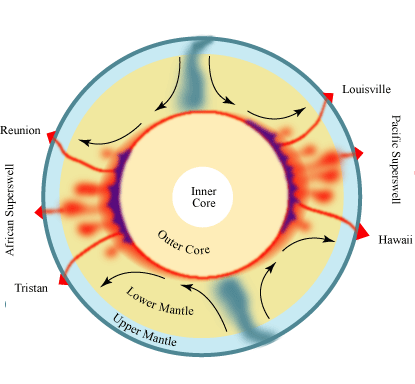
Cartoon created by Helge Gonnermann (from Jellinek and Manga, Reviews of Geophysics, 2005), showing some of the
structures that might exist and processes that might occur within
the mantle.
Return to Michael's
home page